Morocco Green Hydrogen Push:
Catalyst for Industrial Transformation or Export-Led Growth?
By Hicham Bouzekri
March 11 2026
As the global economy accelerates decarbonization initiatives, emissions from hard-to-abate sectors—such as steel production and refining—are increasingly central to net-zero strategies. The growing international consensus is that green hydrogen, produced through renewable-powered water electrolysis, is one of the most promising pathways to decarbonize these sectors. Morocco, a country currently importing 90% of its energy needs, has ambitions to be a key global exporter of green hydrogen derivatives.
Globally, the majority of green hydrogen is converted into widely traded derivatives— particularly green ammonia—which is easier to transport and store. Ammonia production is the second-largest market for hydrogen after refineries, according to the International Energy Agency (IEA). Despite relatively limited global trade volumes, it accounts for around 2% of global energy consumption. Its manufacturing process is highly energy-intensive, requiring approximately 46 GJ per ton of ammonia produced.
In terms of greenhouse gas (GHG) emissions, the production of one ton of conventional ammonia is responsible for around 2.4 tons of CO₂, resulting in 450 million tons of CO₂ emissions annually, the equivalent of 1.2% of global CO2 emissions. Approximately 70% of global ammonia output—estimated at 182 million tons per year in 2024— is used in fertilizer manufacturing, a sector critical for global food security and expected to grow in line with rising populations and increasing purchasing power in emerging economies.
Unless the right policies are enacted, Morocco’s green hydrogen program can squander a once-in-a-generation opportunity to establish domestic manufacturing of renewable energy and green hydrogen equipment
Morocco’s Critical Position
Morocco’s phosphate conglomerate, Office Chérifien des Phosphates (OCP Group), controls the world’s largest phosphate reserves and has transformed over the past two decades from a raw phosphate rock exporter into a leading global fertilizer producer. This shift has made Morocco one of the world’s largest importers of ammonia—the country currently ranks third behind the United States and India.
In December 2022, OCP Group signed a $13 billion investment agreement with the Moroccan government to fully decarbonize its energy consumption. A cornerstone of this strategy is the production of 1 million tons of green ammonia by 2027, expanding further to 3 million tons by 2032 to replace imported ammonia. If completed, this would reposition Morocco as a top ten global producer of green ammonia with the potential to strengthen the national economy and improve the country’s trade balance. In addition to the economic benefits, OCP's planned transition toward domestic green ammonia production lends credibility to the country as an emerging investment destination in the sector.
Building on this foundation, the Moroccan government launched the Morocco Green Hydrogen Offer (MGHO) in March 2024 to attract export-oriented investments in green hydrogen and its derivatives. The MGHO earmarked 1 million hectares of primarily public land for green hydrogen production and designated the Moroccan Agency for Sustainable Energy (MASEN) as a single-entry point for investors.
Initial investor interest has been strong, with the Moroccan government announcing, in August 2024, expressions of interest from 40 investor consortia from four continents. In March 2025, the government announced the selection of seven projects to advance to the next stage of investment contract negotiations, with one having signed initial land reservation contracts to date. The first wave of MGHO projects is expected to add 16 GW of renewable energy capacity—equivalent to nearly 150% of Morocco’s current installed electricity generation capacity. Additionally, a recent World Bank study, conducted in collaboration with the Moroccan government, has outlined an infrastructure investment roadmap for the four ports of Dakhla Atlantic, Tanger-Med, Jorf Lasfar, and Tan-Tan to enable trade of green hydrogen derivatives at scale.
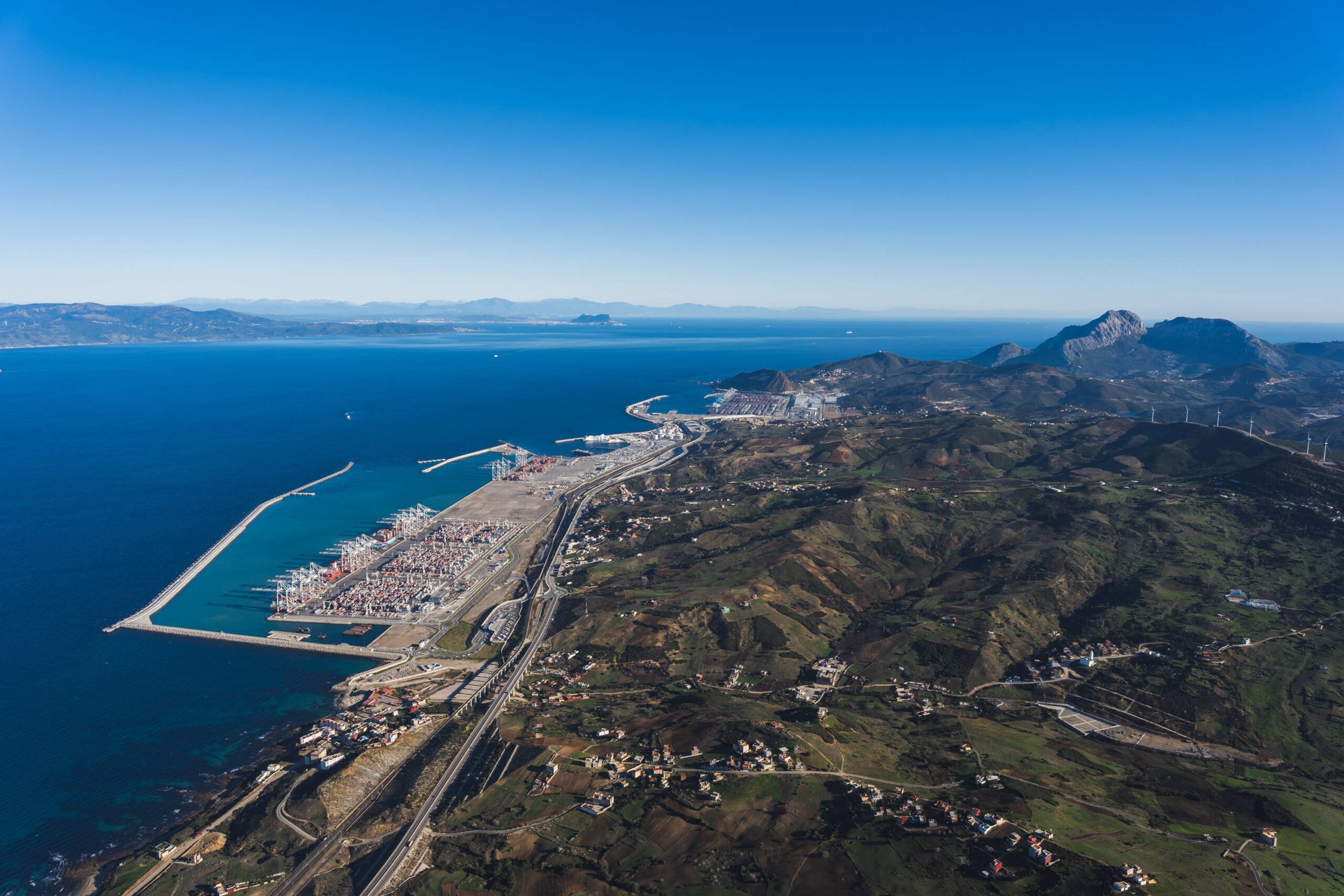
Tanger Med, located at the Strait of Gibraltar, is one of the largest container ports in Africa and a candidate green bunkering hub for vessels transiting one of the world's busiest maritime corridors. Photo: Raid Laabi
Industrial Development: A Missed Opportunity?
From an industrial development perspective, the scale of Morocco’s green hydrogen program presents a unique opportunity to stimulate domestic manufacturing of renewable energy and green hydrogen equipment. However, as the MGHO framework does not currently include local sourcing requirements, there are limited incentives for investors to engage with domestic suppliers or build a local supply chain.
In addition, negotiating investment projects individually limits the potential for cross-project synergies, such as shared manufacturing facilities for photovoltaic panels, wind turbines, or electrolyzers that could serve multiple projects.
The social dimension also warrants careful consideration. The MGHO invites international investors to compete on local value creation proposals, which is an innovative approach but may not align with Morocco’s regional development strategies that prioritize job creation through upskilling of the local workforce and industrial equipment manufacturing.
Since the 2011 constitutional reforms, which emerged in response to the Arab Spring, Morocco has institutionalized regional development plans to address socio-economic disparities between central and peripheral areas. It remains uncertain, however, whether the infrastructure required for green hydrogen production and export will align with local development priorities—including access to transportation, healthcare, education, and water, the development of value-added agriculture, and job creation for low-to-medium skilled workers.
Recent demonstrations led by Gen-Z activists have shown that large-scale infrastructure projects perceived as disconnected from local socio-economic needs can lead to public discontent and social unrest.
Morocco's transformational green fertilizer investments can jump-start its ambition to transform into a net (green) energy exporter for the first time in its history
Between Ambition and Alignment
Morocco’s Green Hydrogen policy is set to position the country as an early mover in the new regional green hydrogen economy. Exporting green hydrogen derivatives to Europe could help Morocco improve its trade balance and diversify its energy partnerships. The MGHO also has the potential to transform Morocco from an energy-import economy to a net energy exporter. The initiative capitalizes on the country’s successful renewable energy experience by adopting a phased approach that favors off-taker/developer consortia proposing a positive impact on the local economy while preserving the competitiveness of exports.
The scale of the consolidated equipment demand generated by MGHO projects could create a viable local pipeline for equipment manufacturing ecosystems, securing more permanent employment opportunities. This once-in-a-generation transformational opportunity will only materialize through a more proactive and locally focused industrialization policy set by the government as a framework for negotiations with selected bidders.
The program’s long-term developmental impact on the country will depend on how policymakers choose to shape the associated regulatory and industrial frameworks. Relying exclusively on project promoters' proposals risks misalignment with regional development priorities and could generate popular resentment.
Hicham Bouzekri is a Senior energy transition expert.