Hydrogen’s Role in GCC Decarbonization:
From Strategy to Delivery
By Carlos Méndez
May 25 2026
The Gulf Cooperation Council (GCC) countries are among the world’s largest producers of oil and gas and have some of the highest per capita greenhouse gas emissions globally. Each has committed to emission-reduction targets under the Paris Agreement, ranging from Qatar’s 25% emission reduction target by 2030 to ambitious net-zero targets by 2050 in Bahrain, Kuwait, Saudi Arabia, Oman, and the UAE. Meeting these targets requires expanding renewable energy capacity, pursuing economic diversification, and finding ways to reduce emissions in hard-to-abate sectors, where emissions are tied to energy-intensive processes that cannot be addressed by electrification or fuel switching alone.
Low-carbon hydrogen offers a potential path forward. Produced from renewable energy or from natural gas with carbon capture technology, this fuel can reduce emissions in energy-intensive sectors such as iron and steel, cement, and chemicals, and complement decarbonization and economic diversification efforts. In recognition of hydrogen’s potential, GCC governments have launched strategies, roadmaps, and initiatives in recent years but, so far, delivery has failed to keep pace with the scale of ambition. This raises the question of where hydrogen realistically fits within the GCC’s decarbonization efforts, and what is holding progress back.
Ambition and Reality: A Country-by-Country Assessment
Oman was the first GCC country to publish a hydrogen roadmap. Its 2022 Green Hydrogen Strategy targets production of up to 8.5 million metric tonnes per year (Mtpa) of green hydrogen – produced using renewable energy plus water electrolysis – by 2050. This is in service of five strategic objectives with industrial decarbonization being the near-term priority. A dedicated body, Hydrom, oversees delivery. To date, two auction rounds have been completed and a third is expected by mid-2026. Multiple land blocks have been awarded to projects targeting overall production of over 1.3 Mtpa of green hydrogen. However, most of these remain at early stages, and few have reached final investment decision, largely because without an established hydrogen market, securing long-term offtake agreements remains difficult.
The UAE has set a more ambitious production target of 14.9 Mtpa by 2050 under its National Hydrogen Strategy, broadly split between green hydrogen and blue hydrogen – the latter produced from natural gas integrated with carbon capture – with 5% met using nuclear-energy-produced pink hydrogen. Its strategy prioritizes domestic use with almost 68% of production allocated to national decarbonization and between 4.8 Mtpa and 9.6 Mtpa allocated for export. As with Oman, however, project execution details are limited.
Saudi Arabia has no formal hydrogen strategy but has made the most tangible progress. Construction of the NEOM Green Hydrogen facility, which is set to produce 600 tonnes per day, was over 80% complete as of early 2025. The kingdom has also signed several agreements with European partners for green hydrogen exports, including agreements with Germany’s EnBW and SEFE for 400,000 tonnes per year and 200,000 tonnes per year, respectively. These developments make Saudi Arabia the region’s forerunner in terms of project delivery.
Bahrain and Kuwait have taken early steps. Bahrain’s Industrial Sector Strategy (2022–2026) identifies blue and green hydrogen as a target sector. The country has also signed agreements with Air Products for a hydrogen economy assessment. Kuwait has commissioned a Renewables and Hydrogen Masterplan Project for its national oil company. Neither has a dedicated roadmap or a major project under development.
Qatar has taken a different approach, focusing on specific projects rather than publishing a strategy. Its upcoming 1.2 Mtpa blue ammonia plant, due online in 2026, and a pilot plant project that produces green hydrogen from wastewater, represent concrete – if limited – steps. In 2021, QatarEnergy and South Korea’s Hydrogen Convergence Alliance also inked a cooperation agreement on hydrogen sector development.
At the regional level, GCC countries participating in the Organization of Arab Petroleum Exporting Countries (OAPEC) launched a Hydrogen Guidance Initiative in April 2025, aimed at coordinating blue and green hydrogen development. However, it is too early to assess its impact.
Across the GCC, the gap between stated ambition and tangible progress is striking. Strategies may be in place, but with Saudi Arabia’s NEOM as the notable exceptions, relatively few projects have moved past the planning phase.
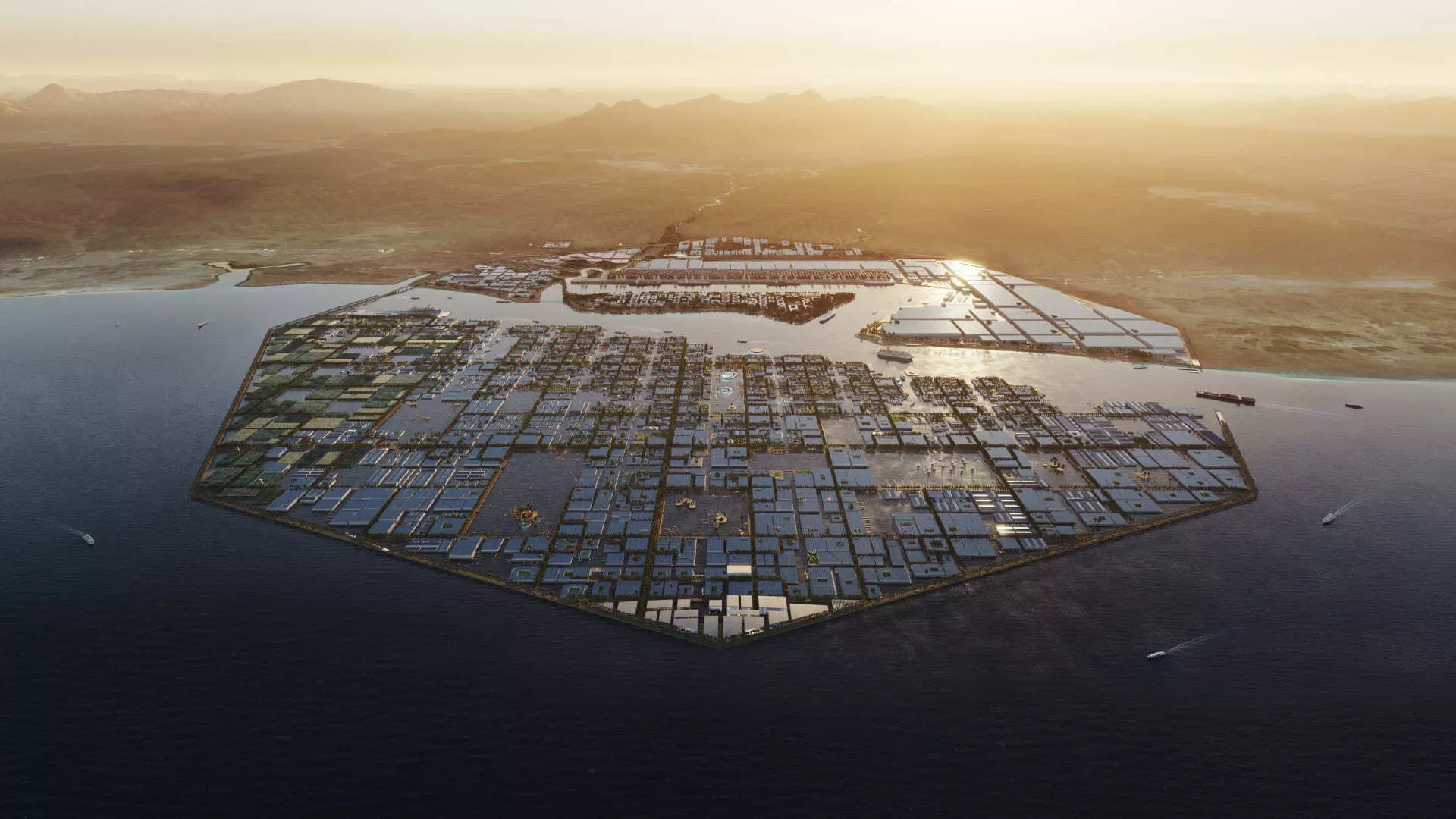
NEOM, Saudi Arabia — home to the GCC's most advanced green hydrogen facility and one of the few projects in the region to have moved from strategy to construction. Photo: NEOM
Where Hydrogen Can Make a Difference
All GCC countries have existing expertise in hydrogen production, primarily through its use in oil refining, chemicals, and petrochemicals. This knowledge provides a foundation for transitioning from gray hydrogen – produced from natural gas without carbon capture – to low-carbon alternatives. For instance, Qatari oil and chemicals industries account for approximately 1.3% of global hydrogen demand, all of it met by gray hydrogen. Since oil and gas and heavy industry together account for more than 65% of the country’s emissions, switching to low-carbon hydrogen in these sectors could make a significant contribution to its 25% emissions reduction target.
Similar transitions are already being explored elsewhere in the Gulf. In Oman, Meranti Green Steel plans to begin steel production using a natural gas and hydrogen blend before eventually transitioning to fully green hydrogen. These efforts are supported by the region’s production cost advantage: by 2030, green hydrogen could cost as little as US$4.00 per kilogram in parts of the GCC, while blue hydrogen could fall below US$1.50 per kilogram, making it the lowest-cost low-carbon production pathway in the world.
Low-carbon hydrogen could also play a supporting role in sectors other than heavy industry, such as transport, where it can serve as both a complement to battery electric vehicles and as a cleaner alternative to diesel for long-haul freight. However, hard-to-abate sectors represent the clearest and most immediate opportunity for hydrogen in the GCC.

By 2030, green hydrogen could cost as little as US$4.00 per kilogram in parts of the GCC, while blue hydrogen could fall below US$1.50 per kilogram making it the lowest-cost low-carbon production pathway in the world
What Is Holding Progress Back
Despite abundant natural resources and the economic capacity to invest, GCC countries have been slow to move hydrogen projects from planning to delivery. The primary obstacle is a lack of buyers for long-term offtake agreements, as this prevents projects from attracting the financing needed to proceed. To date, Saudi Arabia’s NEOM facility and Oman’s Yara-ACME agreement – which secures 100,000 tonnes per year of renewable ammonia – are the only GCC projects with confirmed full offtake. This scarcity of demand discourages investment and extends return-on-investment timelines to unattractive levels. Cost is a compounding factor. As of 2024, green hydrogen cost at least five times more to produce than gray hydrogen. This premium is difficult to pass on to buyers unless their own customers are specifically seeking low-carbon commodities. Retrofitting existing gray hydrogen facilities with carbon capture technology also disrupts production during the transition, with knock-on effects for revenue.
Competition for renewable energy adds further pressure. Hydrogen production requires large amounts of low-cost renewable power; however, that same power is required to meet broader decarbonization targets across multiple sectors in all GCC countries. For example, Kuwait, Qatar, and Saudi Arabia have set renewable energy targets of 15%, 18%, and 50% of their energy mix by 2030, respectively. These targets will compete directly with hydrogen production for prime sites and capacity.
Water scarcity, while not seen as the primary barrier, presents an environmental constraint. Across the GCC, a large volume of water consumed – from 42% in the UAE to 99% in Qatar – is obtained via desalination. Green and blue hydrogen production requires, on average, between 17.5 and 32.2 liters of water per kilogram of hydrogen produced. Desalination is a viable solution but without careful water management, scaling up hydrogen production could place additional stress on the Arabian Gulf ecosystem.
As of 2024, green hydrogen cost at least five times more to produce than gray hydrogen
The Path to Delivery
Despite the significant barriers, low-carbon hydrogen remains a viable and important option for decarbonization across the GCC. The clearest near-term opportunity lies in replacing gray hydrogen in existing industrial processes and enabling the export of downstream low-carbon products such as ammonia, iron, and steel. Qatar’s blue ammonia plant and the UAE’s plans to direct 62%of its clean hydrogen – as feedstock for methanol and ammonia production, and as a reducing agent in steel manufacturing by 2031 – illustrate this trajectory. It also positions the GCC to meet emerging trade policies that penalize carbon-intensive exports, such as Europe’s Carbon Border Adjustment Mechanism.
Export of hydrogen itself remains an aspiration for several GCC members, and their natural resources make it a credible long-term ambition. However, an underdeveloped international market and the absence of committed buyers mean it cannot yet be a primary focus.
Ultimately, low-carbon hydrogen’s mid-to-long-term role in the GCC depends on finance and offtake. Strategies and targets are important, but progress depends on securing long-term buyers and the development of a stable international market for hydrogen and clean commodities. How quickly that market develops will, more than any other factor, determine the pace and scale of the GCC’s hydrogen transition.
Carlos Méndez is a Postdoctoral Researcher at the Qatar Environment & Energy Research Institute (QEERI), specializing in hydrogen strategy, energy systems modelling, and long-term decarbonization pathways in the GCC.