


Balancing the Grid and Geopolitics:
The Gulf’s Renewable Energy Cooperation with China
By Yunis Sharifli
Feb 10 2026
In 2024, China accounted for 80 percent of global solar panel production capacity across the manufacturing value chain, a concentration that shapes renewable energy deployment worldwide, including in the Gulf. As Gulf countries rapidly accelerate domestic renewable energy deployment to diversify their economies and reduce long-term dependence on fossil fuels, they are increasingly relying on supply chains concentrated in China to support this transition. While this partnership offers clear economic benefits, it also exposes the region to technological, cybersecurity, and geopolitical vulnerabilities. To secure a resilient and autonomous green energy future, the Gulf states must balance their reliance on China by diversifying their supplier base, strengthening local innovation, and coordinating regional industrial strategies.
As global decarbonization accelerates, the United Arab Emirates (UAE) and Saudi Arabia have positioned themselves as major players in renewable energy capacity and low-carbon investment, including green hydrogen. The UAE's Masdar expanded its clean energy portfolio to approximately 65 gigawatts (GW), aiming to reach a 100 GW global portfolio by 2030 through major acquisitions across Europe. Saudi Arabia's ACWA Power announced USD 10 billion in new clean energy agreements, advancing projects from Central Asia to the Caucasus. These investments signal not only environmental ambition but also a rapid economic strategy to build revenue streams that will outlast the fossil fuel era and to secure influence in the global energy transition.
Against the backdrop of rapid expansion in green energy investment, China has emerged as a central partner in the supply of renewable energy technologies and equipment, driven by its overwhelming dominance in renewable technology manufacturing. China accounts for nearly half of global installed solar power capacity, at approximately 47.5 percent in 2024 and projected to exceed 50 percent in 2025. At the manufacturing level, China holds a near-monopoly over photovoltaic wafers and cells, the most technologically complex segments of the value chain, with market shares of 96 percent and 85 percent, respectively.
These components sit at the most critical stage of the solar value chain because they require highly specialized manufacturing equipment, advanced process know-how, ultra-pure materials, and tightly integrated supply chains that are difficult and costly to replicate. China’s current position is the result of decades of investment across every step of production, from materials processing to precision manufacturing and scale deployment. For Gulf states seeking rapid and cost-effective expansion of renewable energy, Chinese firms offer competitive advantages in product scale, speed, and affordability, reinforcing their central role in the region’s renewable energy deployment.
This reliance on Chinese components is visible in major projects across the region. The Sudair Solar PV plant in Saudi Arabia uses modules supplied by LONGi, one of the world’s largest Chinese solar panel manufacturers, while the Al Dhafra project in the UAE incorporates trackers produced by Arctech, a leading Chinese provider of solar tracking technology. Such partnerships support Gulf states' ambitions to reduce dependence on fossil fuels and to build long-term income streams through investments in renewable energy abroad.
However, the reliance on China also brings risks that could undermine the Gulf’s energy transition. These risks include technological dependence, exposure to cybersecurity vulnerabilities, and broader geopolitical pressures. These risks could undermine the long-term sustainability of the Gulf’s energy transition.

At the manufacturing level, China holds a near monopoly over photovoltaic wafers and cells, the most technologically complex segments of the value chain
Technological Dependency Risk
One of the most significant long-term risks is the possibility of becoming technologically locked into the Chinese renewable energy ecosystem. Despite the Gulf’s differing national strategies, this dependence could limit Gulf states’ abilities to diversify their supplier base, adopt alternative technologies, or adjust energy policy as global market conditions change. The UAE prioritizes rapid deployment through a flexible, market-driven model that does not impose strict localization requirements. Saudi Arabia, in contrast, pursues an ambitious industrial policy centered on building a domestic manufacturing base to achieve a 75 percent localization target across the energy sector by 2030.
In the UAE, reliance on Chinese imports has deepened as renewable energy capacity, particularly solar, has expanded. In 2022 and 2023, over 98 percent of solar modules imported by the UAE originated in China, indicating a significant dependence on China for critical components of the UAE's energy transition.
This dependence is especially significant given that the UAE aims to achieve nearly 20 gigawatts of renewable capacity by 2030, with solar accounting for the majority of generation, and to increase the share of clean energy to 44 percent by 2050. As solar capacity continues to scale rapidly, the UAE’s energy transition is therefore increasingly tied to sustained access to Chinese solar components, reinforcing long-term supply chain dependence.
This dependency is likely to persist as the UAE advances its deployment of renewable energy. The UAE plans to achieve nearly 20 GW of renewable capacity by 2030, with solar planned to account for the majority of energy generation, and to increase the share of clean energy to 44 percent by 2050. Without supply chain diversification, the UAE’s energy transition risks being dependent on sustained access to Chinese solar components, reinforcing long-term supply chain dependence.
Saudi Arabia seeks to avoid this outcome by negotiating manufacturing investments directly with Chinese firms, reflecting the scale of its renewable ambitions. The Kingdom’s renewable project pipeline is larger than that of the UAE, driven by ambitious Vision 2030 targets, whose timelines necessitate rapid deployment across multiple projects, each with several GW of new capacity.
To advance this, Saudi Arabia’s Public Investment Fund has signed major joint ventures with JinkoSolar and TCL Zhonghuan Renewable Energy. The TCL Zhonghuan agreement aims to establish domestic production of ingots and wafers, while the JinkoSolar venture will add 10 GW of n-type solar cell and module capacity to Saudi Arabia’s domestic production. Domestic manufacturing capacity offers advantages such as job creation and a localized supply chain, and positions Saudi Arabia as a regional hub for solar manufacturing.
Yet the depth of technology transfer remains limited. China is not relocating its most advanced or strategically sensitive capabilities. Instead, it is localizing mid-tier segments of the value chain while keeping the upstream intellectual property and high-value processes firmly within its borders. Saudi Arabia may gain substantial manufacturing capacity, but the critical inputs, production equipment, and future technological upgrades will continue to originate from China. Localization may therefore strengthen the Gulf’s renewable ambitions while simultaneously replicating structural dependence on Chinese supply chains.
Cybersecurity Risk
Technological lock-in also introduces long-term cybersecurity vulnerabilities for critical Gulf infrastructure. This has been underscored by growing concern in Europe and the United States surrounding Chinese-manufactured solar inverters. Inverters convert energy andconnect systems to external platforms for monitoring, remote management, software updates, and overall control.
Both Saudi Arabia and the UAE rely on Chinese inverters, which are often managed remotely via platforms hosted in China. These systems fall under Chinese jurisdiction, meaning that access, data governance, and operational parameters are subject to Chinese regulatory and legal decisions. This places the Gulf states’ critical infrastructure and energy networks outside their physical and legal jurisdiction and creates a dependence on the security and reliability of China’s digital infrastructure.
In a worst-case scenario, a deliberate or accidental remote shutdown could disable thousands of inverters simultaneously, resulting in a catastrophic, sudden loss of solar-generated power and significant disruption to energy supply and grid stability. It would also place immediate pressure on backup power systems, known as spinning reserves, which are generators kept running to quickly compensate for unexpected supply losses. To develop a resilient grid network and ensure mitigation strategies in the event of inverter connectivity loss, building and integrating reliable backup supplies will be essential as a backstop if Chinese digital infrastructure is compromised. Without such safeguards, Gulf states risk cybersecurity vulnerabilities becoming embedded in their energy transition and critical infrastructure.
Even without direct intervention, the mere existence of such linkages can shape strategic calculations by reminding policymakers that parts of their national grid depend on foreign digital infrastructure
Geopolitical Risk
The final major risk comes from geopolitical competition. China is now the Gulf’s primary renewable technology supplier, while the United States remains the region’s main security guarantor. Managing deep economic ties with China alongside longstanding security cooperation with the United States has, to date, enabled Gulf states to maintain parallel relationships without formal alignment with either side. However, rising tensions between Washington and Beijing make this equilibrium harder to maintain.
Both powers have increasingly leveraged trade and technology as strategic tools, including the United States’ use of tariffs, export controls, and investment restrictions on Chinese clean energy technologies, and China’s tightening of controls over critical materials and components across renewable energy supply chains. These measures add uncertainty for Gulf states whose energy strategies depend on stable access to global technology markets.
If great-power competition intensifies, Gulf states may struggle to manage their relations strategically with the US and China. The United States may consider secondary sanctions or tariff measures targeting Chinese-linked renewable energy projects, particularly in sectors deemed strategically sensitive. China, by contrast, is less likely to resort to broad export restrictions given its current economic constraints and the importance of Gulf markets for Chinese firms. Instead, China may leverage its economic interests, such as its significant stake in Saudi Arabia’s ACWA Power, or its growing diplomatic engagement with Gulf states, to shape policy choices behind the scenes.
This vulnerability is compounded by the Gulf's heavy technological dependence and cybersecurity exposure embedded in its current renewable energy partnerships with China. If political pressure intensifies, the Gulf could find itself caught between its security partner and its technology partner, with both sides leveraging their respective strengths.
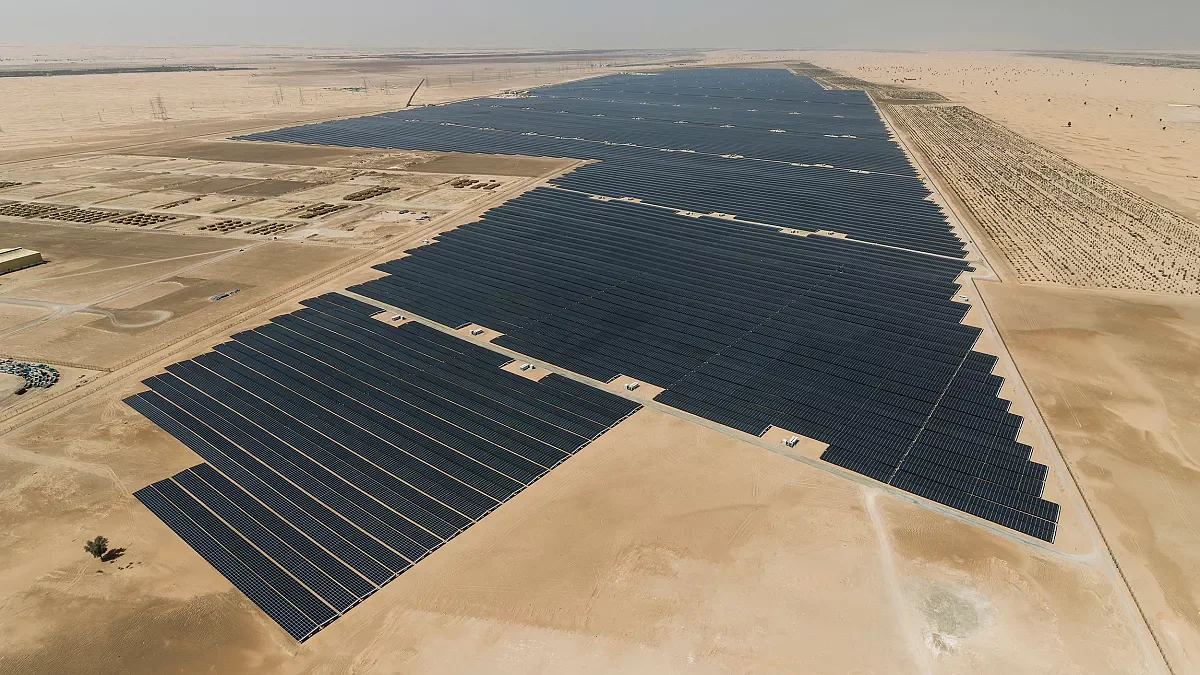
Upon completion in June 2023, Al Dhafra was the world’s largest single-site solar plant, using almost 4 million bifacial solar panels to generate enough electricity for approximately 200,000 homes across the UAE.
Recommendations
To reduce these risks, Gulf states must take strategic steps to build a more autonomous green energy ecosystem. The first priority is to diversify suppliers by deepening partnerships with a broader range of technology providers, including those based in Europe, the United States, South Korea, and Japan. Broadening these relationships would reduce dependence on Chinese components and strengthen access to alternative sources of expertise. Sovereign wealth funds (SFWs) can play a catalytic role in this process by leveraging their balance sheets to de-risk market entry for alternative suppliers through instruments such as co-investments, guarantees, and blended finance structures.
By providing early-stage capital, risk-sharing mechanisms, or credit enhancements alongside private investors, SWFs can help reduce financing costs and commercial uncertainty for non-Chinese firms seeking to localize manufacturing or deploy technology in Gulf markets, while remaining aligned with their commercial mandates.
The second priority is to invest more heavily in research and development (R&D). The Gulf Cooperation Council (GCC) spends roughly one-third of the global average on R&D, far below the OECD average of around 3 percent of GDP. As China and the West become more cautious about sharing advanced technologies, Gulf countries must build their own long-term innovation capacity. Expanding domestic funding, developing local talent, and partnering with global research institutions will be essential for creating a sustainable ecosystem of green technology innovation.
The final priority is regional coordination. Rather than each country developing a full renewable energy supply chain independently, the Gulf states should specialize in specific components based on their comparative advantages. A coordinated approach would reduce duplication, build economies of scale, and improve the region’s overall competitiveness.
Through supplier diversification, sustained investment in research and development, and coordinated regional specialization, the Gulf states have an opportunity not only to reduce technological and cybersecurity risks but to shape the next phase of their energy transformation on their own terms. By moving beyond a model of dependency toward one of strategic autonomy, the region can leverage its financial strength, policy coordination, and growing industrial base to become a credible hub for clean energy innovation rather than a passive consumer of imported technology. In doing so, the Gulf would strengthen the resilience of its energy systems, preserve its diplomatic flexibility, and position itself as a confident actor in an increasingly fragmented and competitive global energy order.
Yunis Sharifli is a researcher specializing in China’s energy diplomacy, regional connectivity, and geopolitical strategy in Central Asia and the Caucasus.
