

Tackling the Middle East and North Africa’s
Climate Crisis Demands a Spotlight on Debt
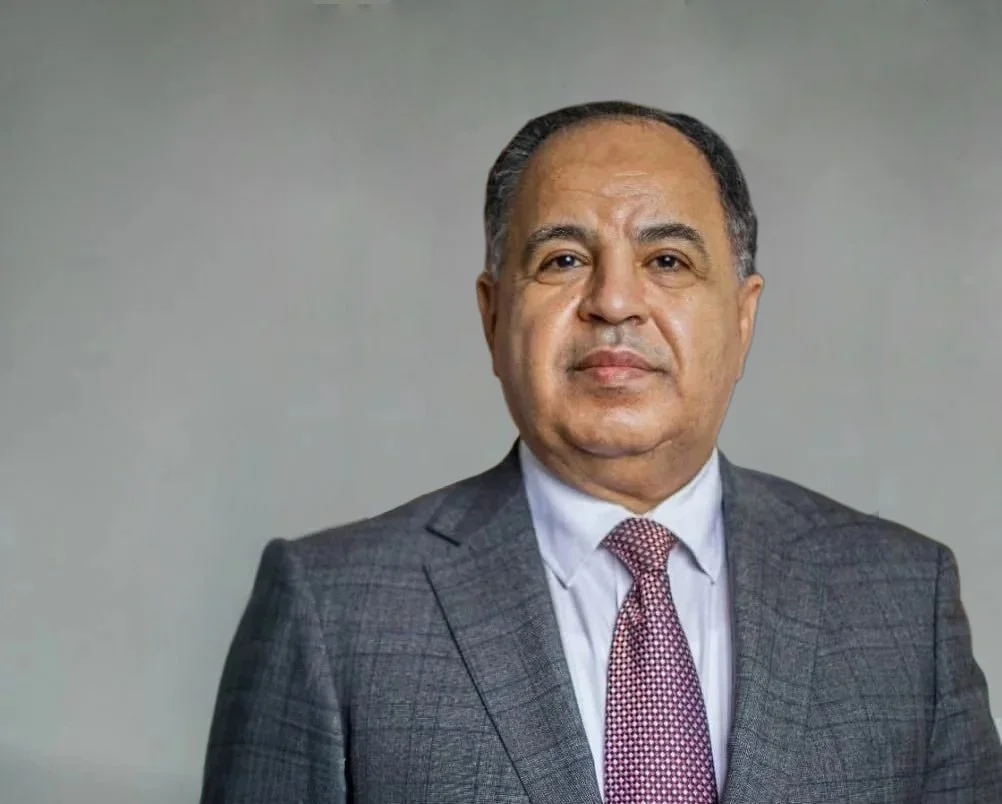
In Dialogue with Mohamed Maait, Executive Director of the International Monetary Fund (IMF) for the Arab countries and the Maldives
By Dina Zayed | March 4, 2026
Heat is rising across the Arab world – and so is debt. As temperatures climb and climate crises intensify, the region must navigate a cruel arithmetic: every climate disaster demands billions for recovery and adaptation, but most governments are drowning in debt. If the region is to face the climate crisis, pragmatic solutions to tackle large debt burdens will need to take centre stage, Mohamed Maait said in an interview with the Carboun Institute.
The Arab world’s 480 million people face intensifying climate conditions. In some places, those include what the World Meteorological Organization (WMO) describes - in its very first State of the Climate report for the region - as ‘unsurvivable heat.’ 2024 was the region’s hottest year on record, with heatwaves hitting Egypt, Iraq, Jordan, Syria, and other countries. Iraq recorded 6 to 12 days of temperatures of about 50 degrees Celsius.
That same year, the region endured 35 extreme events – with flash floods leading the charge. But climate change is not just a crisis to weather; it is a structural reality to reckon with. Shifting health burdens, faltering food systems, and stunted economic growth are just a few examples of the long-term systemic pressures climate change poses for the region. One IMF staff assessment puts it in stark terms: a single degree of warming across just five of the region's hottest countries would slash per capita economic growth by 2 percentage points.
Yet bilateral and multilateral climate finance for the Arab region remains among the lowest in the world – and what does arrive comes mostly as loans, not grants. Meanwhile, as climate records have shattered, the region's debt too has soared to new heights. A perfect storm of structural pressures reflecting both global economic asymmetries and domestic fiscal pressures has pushed external debt to $443 billion by the end of 2023, its highest point in a decade. Inflation, rising interest rates, currency volatility, sluggish growth, procyclical lending, and soaring debt servicing costs mean that many regional governments are carrying a debt burden that leaves little fiscal room to absorb climate shocks, let alone finance the transition ahead.

Bilateral and multilateral climate finance for the Arab region remains among the lowest in the world – and what does arrive comes mostly as loans, not grants
“Every decision for resilience and sustainability for governments in the region involves complex trade-offs and interdependence,” Maait, Egypt’s former minister of finance from 2018 to 2024 and member of the IMF Executive Board, said in an interview. “We should not be waiting for more crises to occur. We have seen in Libya, Egypt, Sudan, and Morocco, to name a few countries, what climate impacts look like.”
“The issue will remain that we need finance and it has to be at an affordable cost,” Maait, the Executive Director, representing Arab countries and the Maldives, added.
Debt burdens and their histories of evolution are highly uneven and heterogeneous across the region. Aggregate figures can flatten considerable nuance and complexity across countries. For example, Egypt and Morocco had the highest external debt levels in the region, at about $163.7 billion and $69.3 billion, respectively. Yet, Egypt’s debt looks manageable as a share of GDP, in comparison to countries like Lebanon, with a debt-to-GDP ratio that hit 140% by the end of 2024, or Sudan, with a public debt level that was also severely high at 271.9% of GDP in 2024. Yet, in raw dollars, Egypt’s external debt dwarfs most of its neighbours – reflecting the size of its economy.
The region’s debt burden also offers a tale of inequality within and between the oil-importing and oil-producing countries of the Arab world. On average, debt-to-GDP ratios in the oil-importing countries are virtually triple those of exporting neighbours, and the former had debt-to-GDP ratios that were 50% higher than those of average emerging market economies in 2023.
Debt, like climate change, ultimately hits the most vulnerable and the poorest first and hardest. International research shows that austerity policies routinely disproportionately affect women, and historical evidence points to the cost of public debt and its impact on spending on health, education, and public investment, leaving the most vulnerable citizens to shoulder the financial burden and depleting social welfare and expenditure. Today, the region’s poorest nations are already spending as much as five times as much on debt servicing as on health.
Debt, like climate change, ultimately hits the most vulnerable and the poorest first and hardest
Servicing Debt, Diversifying Solutions
In this light, for much of the region, like most developing economies, the real issue is servicing debt interest. Debt servicing costs are staggering, and increasing costs to service those debts caused net transfers in the region to take an even more negative turn in 2024, with a towering outflow of $29 billion. All creditor-based net transfers were registered as an outflow for the region.
Egypt, Lebanon, Tunisia, and Jordan face the highest debt servicing pressures in the Middle East and North Africa region. The MENAFem Movement for Economic, Development, and Ecological Justice estimates that servicing International Financial Institution debt in the region exceeds the global average and makes up the lion’s share of the region’s external debt servicing costs.
“Debt servicing is a much bigger problem than the debt itself,” Maait said. “If you reduce the cost of servicing, it might give you the space to invest elsewhere, and to focus your fiscal resources on social services and reduce the need for debt itself. But as long as debt servicing is eating up most of your revenue, you have an endless problem.”
When Maait was at the helm of Egypt’s Finance Ministry and the country hosted the United Nations climate summit, he was a champion for institutional and global macroeconomic reforms that would help Global South economies navigate challenging multilateral development bank access and constrained debt conditions. This included initiating and backing key campaigns to highlight debt servicing burdens. Maait instigated and led the launch of the Sustainable Debt Coalition, one of several Global South-led initiatives championing financial architecture reform.
“Growth cannot outpace the debt servicing reality. You can never have revenues that can move and scale that quickly,” Maait added. “When we were setting up the Coalition, the 54 countries in Africa had experienced negative impacts on every single one of their currencies. Our Egyptian pound lost two-thirds of its value because of the pandemic, trade disruptions, and very high inflation and cost of financing. That has a direct impact on how you service your debt.”
Global civil society groups and reform-minded governments are calling for a structural overhaul of how sovereign debt is governed and serviced. A number of reform initiatives include demands to shift from loan-based to grant-based climate finance, using debt pauses more strategically, and reforming IMF surcharge policies that deepen distress in already-struggling economies.
While there is some momentum, most recently at the Fourth International Conference on Financing for Development, reforms might not be moving fast enough in an international climate where aid is down as much as 26% in a mere two years, and key advanced economies and institutions are seen to be blocking progress.
“We need outcomes at the end of the day, but the current global political and economic environment is an obstacle. To shift this reality, we have to focus on action on the ground and show that there are initiatives that work, and that have been successful,” Maait said, proposing that debt-for-climate swaps should be considered more deliberately.
“We have to think of the full spectrum of tools we have, and debt-for climate and debt-for sustainability and other swaps are one practical approach to tackle two connected problems,” he added. “When the focus is on sustainability and climate outcomes, we can deliver wins.”
Debt-for-climate swaps involve creditors agreeing to cancel or reduce a country's debt, or at least cancel debt servicing, in exchange for that nation investing the freed-up money into climate action at home. Proponents argue that they can unlock fiscal space and are a pragmatic bridge forward. But critics contend that the sums involved remain modest relative to actual debt burdens, that swaps can risk becoming a mechanism for creditors to discharge obligations on their own terms, and that they come with democratic accountability trade-offs.
Ultimately, what change could look like in practice will depend on each country's context.
“How a country tackles its debt has to be somewhat custom-tailored,” Maait concluded. “We need to encourage diversity in solutions. We have to pay attention to the political reality and move forward to get real change on the ground.”
*All views expressed reflect the author and the interview with Dr. Maait in his personal capacity, not as a representative or spokesperson for the IMF
Dr. Dina Zayed is an Associate Fellow at the Carboun Institute.
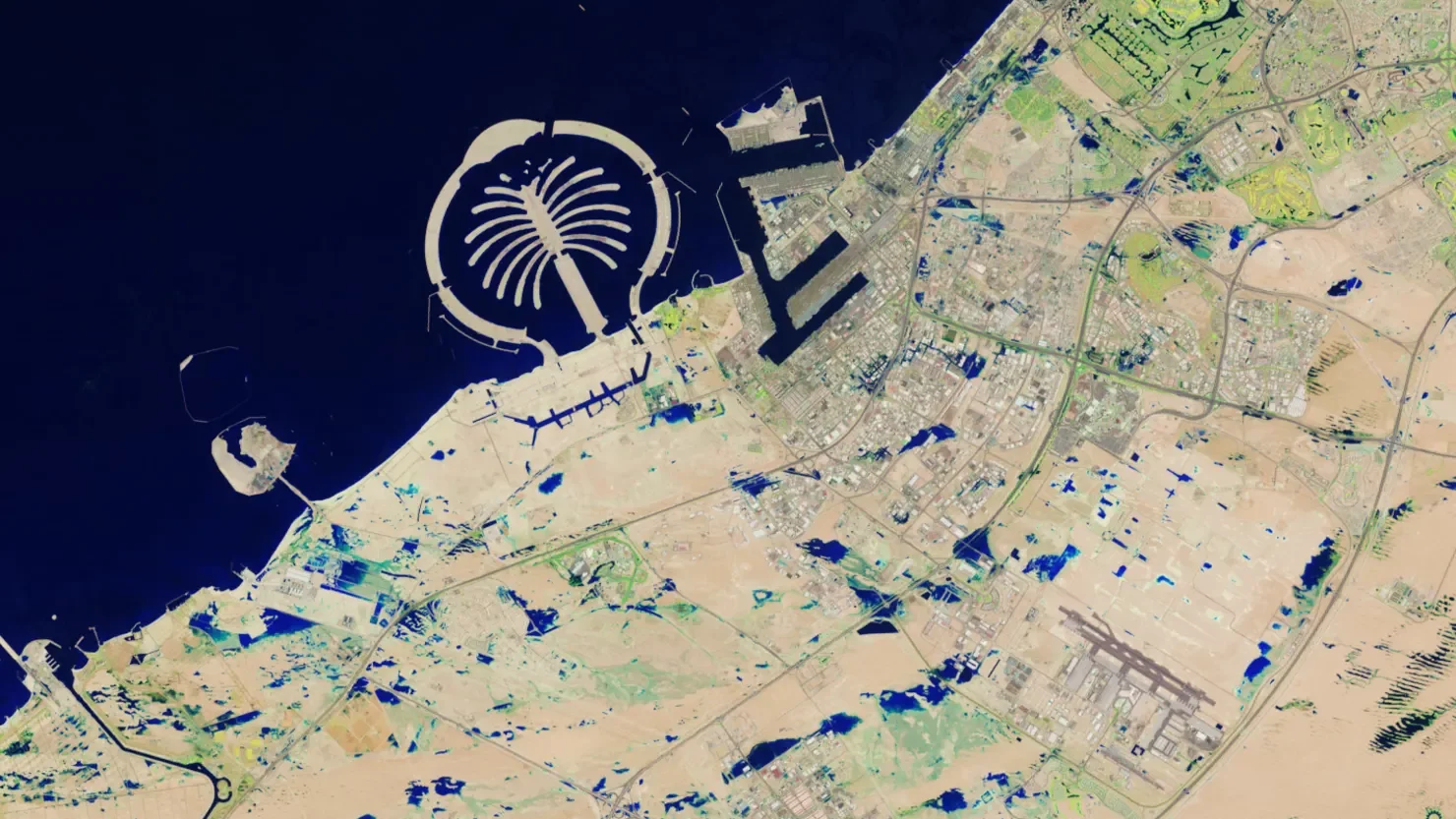
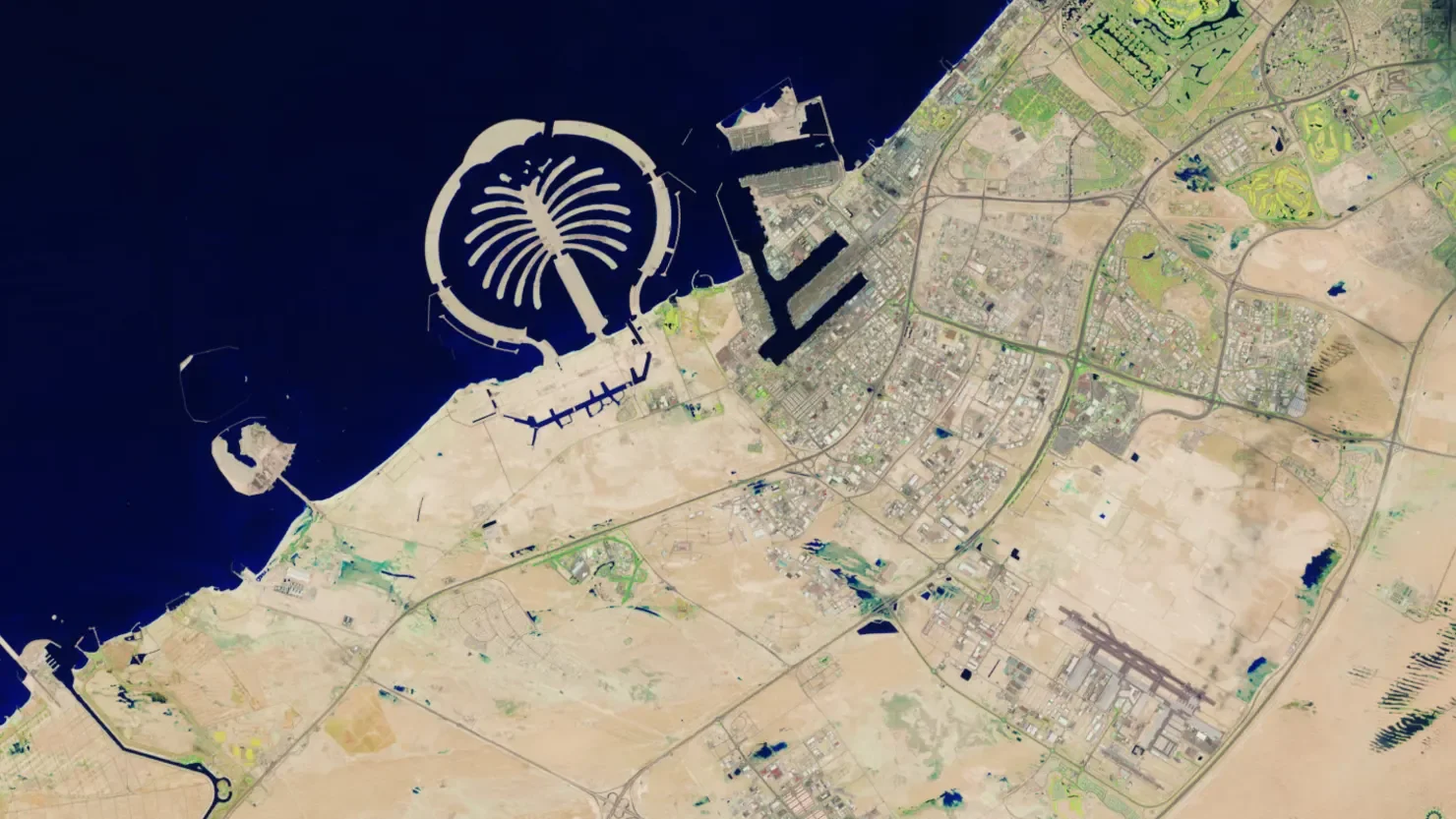
Dubai, UAE — before and after the April 2024 floods. Source: NASA/Landsat 9
