Climate Risks in the MENA Region:
A Systems-Level Assessment
Climate Risks in the MENA Region:
A Systems-Level Assessment
A Report by the Carboun Institute’s Climate Resilience Program
By Karim Elgendy
Climate change constitutes a systemic threat to the Middle East and North Africa (MENA). Intensifying drought, escalating heat extremes, and increasing flood risk are undermining water security, food systems, energy infrastructure, economic stability, and political resilience simultaneously, often exceeding the adaptive capacity of current institutions and development models.
Water scarcity is becoming an absolute constraint on development. The world's most water-scarce region faces projected precipitation declines in key areas. Drought is no longer episodic but persistent: the Levant's worst drought in 900 years (1998–2012) was made two to three times more likely by climate change, while six consecutive failed rainy seasons deepened the crisis across North Africa in 2024. Intensifying drought is forcing acute trade-offs between food production, industrial expansion, and human consumption. These pressures are compounded by the region’s dependency on shared water: 60% of surface water is transboundary, and agriculture accounts for around 80% of total water use—conditions that fuel geopolitical tensions over shared rivers and aquifers.
Extreme heat threatens to render parts of the region economically unviable or physically uninhabitable. MENA is warming at 0.46°C per decade, more than twice the global average. Parts of the Gulf could approach the 35°C wet-bulb temperature threshold by century's end, a physiological limit beyond which humans cannot cool themselves. Areas of Iraq recorded 6–12 days with highs above 50°C in 2024. This creates an acute energy paradox: cooling demand surges as power generation efficiency declines, with air conditioning already accounting for up to 70% of peak electricity load in Gulf states. Heat systematically erodes labor productivity, agricultural viability, and urban habitability.
Flooding in arid regions is emerging as a catastrophic risk. Floods were the most frequently recorded extreme weather hazard across MENA in 2024. Storm Daniel (September 2023) killed thousands in Derna, Libya, when two dams failed. Flash floods routinely overwhelm urban drainage systems. Out-of-season flooding destroys crops yet fails to recharge aquifers as hardened soil sheds rather than absorbs water.
These stresses directly threaten energy transition strategies. MENA accounts for 42% of global operational desalination capacity, with projections suggesting electricity demand for desalination in the MENA region will more than triple by 2035. Without rapid renewable deployment, drought-driven desalination expansion will increase emissions rather than reduce them. Climate stresses are also undermining the region’s broader economic and energy assets. In Morocco, phosphate mining competes with agriculture for water in increasingly arid conditions. Solar power efficiency also declines in extreme heat and dust storms, reducing the reliability of the region’s core renewable energy source at moments of peak demand.
The convergence creates cascading instability. Syria's drought displaced 1.5 million people to cities, contributing to tensions preceding the 2011 uprising. GDP losses by 2050 under 2°C warming could reach 6–14%. Countries managing debt including Egypt, Lebanon, and Jordan face fiscal space narrowing when adaptation investment becomes most urgent. For policymakers, this yields four imperatives:
Treat adaptation as a core economic priority, not a secondary concern.
Embed water and heat constraints into energy transition strategies.
Shift from reactive disaster response to proactive resilience.
Align adaptation and mitigation through integrated climate action.
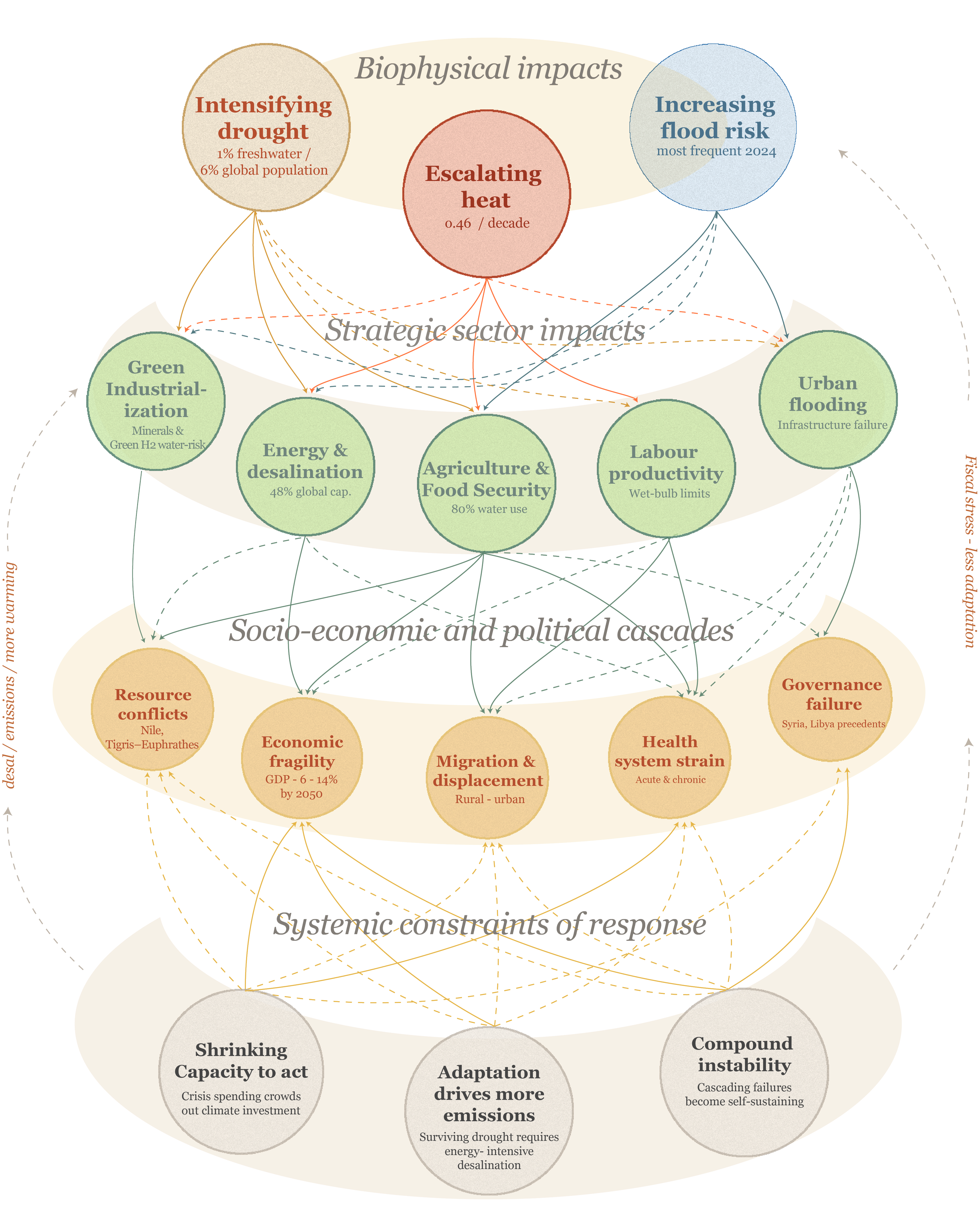
Climate risks in MENA do not operate in isolation. This diagram illustrates how intensifying drought, escalating heat, and increasing flood risk cascade through energy, agriculture, labor, and urban systems, ultimately undermining the region's capacity to adapt. Credit: Carboun Institute
Download the Full Report (English)
تحميل التقرير الكامل (العربية)