|
|
Karim Elgendy
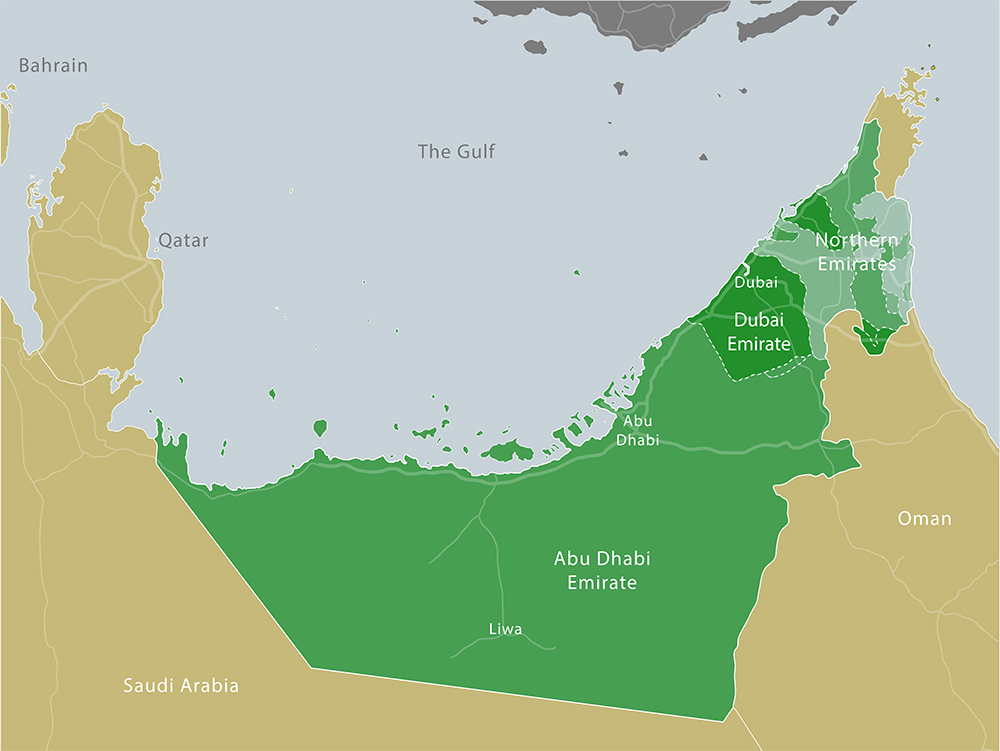
Settling along the shores of the gulf
In the barren deserts of the Arabian Peninsula, people have always settled in locations that provided freshwater and enough natural resources to enable trade and economic development. Human settlements in the southern shores of the Gulf, in what we now know as the United Arab Emirates (UAE), are no exceptions to this.
For the last four centuries, the Bedouins of the Banu Yas tribes have settled a strip of land along the northern edge of the dune fields of the Arabian Peninsula’s Empty Quarter. Drawn to its plentiful ground water resources they established what is now known as the Liwa Oasis and developed date plantations which provided subsistence. But when fresh water was discovered on the Abu Dhabi Island in the late 18th century, Al Bu Falah branch of Banu Yas moved to the coastal location which – in addition to providing fresh water- also allowed them to develop pearling industry and trade.
In the early 19th century, another branch of the Banu Yas, known as Al Bu Falasa, moved from the Abu Dhabi Island to settle near a natural creek 90 miles east of the Abu Dhabi Island. In addition to ground water and pearling, the creek – now known as the Dubai Creek- allowed the establishment of a port which facilitated trade with neighbors across the gulf and beyond. They quickly established a settlement on the western shore the creek – known later as Bur Dubai – but had to abandon it two decades later and move to the eastern shore after a smallpox outbreak. By the end of the 19th century, the combined advantages of fresh water availability, the natural port, the pearling industry, and the good geographic location, were sufficient for the new settlement to endure a sweeping fire that burnt through most of it dwellings. The Bedouins that have settled in Dubai sought no other location and simply rebuilt their settlement.
Continue reading Policies to Buildings: The UAE’s Emergence as the GCC’s Sustainability Leader
Karim Elgendy
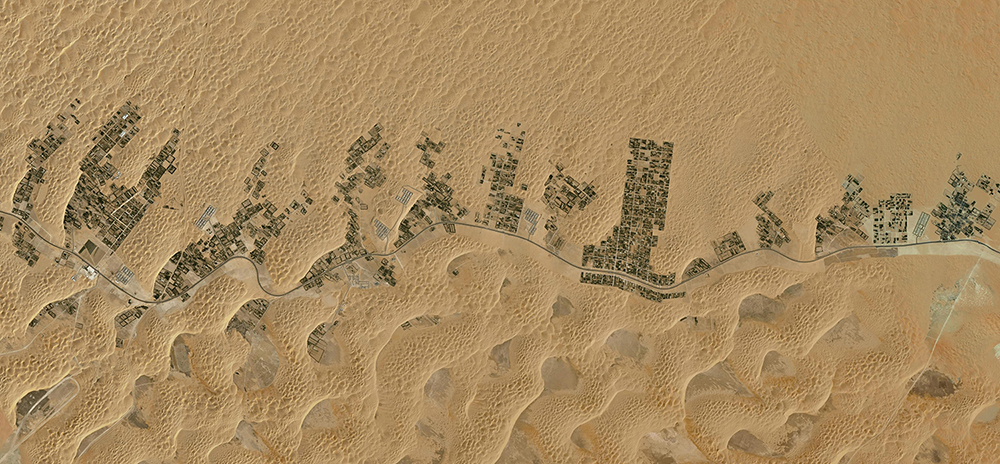 Liwa date farms benefit from some of the freshest ground water in the UAE. Copyrights: Google Those who visit the Middle East and North Africa from more temperate climates are often struck with how hot and dry the region is, and how scarce its rainfall. Some wonder why cities became established here, and how they continue to exist despite the lack of renewable freshwater.
These concerns are not entirely groundless. Yet these cities’ existence is not in any way miraculous: it’s merely an example of what can happen if cities fail to strike a sustainable balance between growth and limited resources.
Continue reading How Sustainable is Your Oasis?: A Review of Water Resources in Middle East Cities
Lara El Saad
Recognised as one of the world’s largest oil producers, Abu Dhabi, the capital of the United Arab Emirates, holds 94% of the country’s proven oil reserves and 90% of its natural gas, making it the wealthiest of the seven emirates in the federation. In recent years, and despite the recent economic downturn, Abu Dhabi maintained a steady pace of development that was accompanied with steady increases in energy demand and consumption.
This growth of energy demand and consumption has been as result of a number factors. Prime amongst which is economic growth and the demographic pressures of a growing population. But equally important to these factors are the heavy subsidies on the domestic energy market, which encourages overconsumption, and the heavy subsidies on domestic water use, which play a major factor in the growth of energy use in Abu Dhabi.
Continue reading Averting Crisis: Managing Energy Use in Abu Dhabi
Wissam Yassine and Karim Elgendy
During the 1990s and the early 2000s, the UAE, and the city of Dubai in particular, witnessed a rapid rate of growth in its built environment driven by a real estate bubble. In the span of a few years the city’s unprecedented rate of growth, which was driven by both demand and speculation, completely transformed the city. But such growth came at a price. Driven by their need for quick returns, developers cared little beyond delivering a building on time and on schedule. Speed of construction often came at the expense of quality, and issues of performance and energy use played almost no role in the design and construction processes. Common disregard of performance was also fueled by the fact that most buildings were commissioned for developers – rather than owner/occupier clients – since their focus lied solely on reducing initial capital expenditures without considering operating costs that are typically borne by tenants.
 Figure 1. Photo of the Masdar Institute Courtyard showing the wind tower, and the layered facades of residential units. Copyrights: Nigel Young/ Foster+Partners These commercial forces, coupled with relatively cheap electricity across the UAE, and a lack of demanding building regulations have paved the way to the development of unsustainable design practices over the last decade. A typical office building in the UAE today is a predominantly glazed high rise tower. Basic design decisions such as orientation, massing, and envelope design are usually made without much regard to their impacts on the buildings’ energy performance, and passive cooling strategies are rarely considered.
Continue reading Passive Cooling: Responding to Electricity Demand in the UAE
Karim Elgendy
As previously reported on Carboun, Masdar City – the $22 billion project of the Abu Dhabi Future Energy Company (Masdar) – is currently under construction and is due to be completed in 2016. As the the first zero-carbon emissions and zero-waste city, the master plan for Masdar City integrates many passive design and planning strategies with renewable energy production to achieve its ambitious sustainability goals.
At the center of Masdar City lies its first building, the Masdar Headquarters, which will become the new home of Abu Dhabi’s Future Energy Company, as well as the secretariat of the International Renewable Energy Agency (IRENA). The building – together with other key building -will act as an anchor and a catalyst for the development of the city.
 Image 1. Rendering of Masdar HQ. Copyrights: Adrian Smith+ Gordon Gill
Continue reading Abu Dhabi’s Masdar Headquarters: The First Positive-Energy Building in the Middle East

Karim Elgendy
UPDATED – In April 2010 the Estidama program of the Abu Dhabi Urban Planning Council partially released the first version of its rating system suite, The Pearls Rating System for Estidama. The release included the design and construction portions of the the rating system suite which includes rating systems for buildings, villas, and neighborhoods.
Prior to its release Estidama has occasionally referred to the upcoming system as one that learns from its established predecessors, the British BREEAM rating system and the American LEED rating system (BREEAM stands for British Research Establishment Environmental Assessment Method, and LEED stands for Leadership in Energy and Environmental Design). The decision to learn from these rating systems was not only to learn from their mistakes but also to help create a system whose requirements are familiar to the market. On the other hand, the Estidama program asserted that the Pearls Rating System would not be a direct copy of either systems given the environmental and cultural differences of the Emirates
Given the debates that exist amongst practitioners and researchers on both sides of the Atlantic on the merits, shortcomings, and differences between BREEAM and LEED. An analysis of Estidama’s Pearls Rating System in comparison to these two established rating systems was necessary. The first version of the Pearls Rating System for Estidama will be compared to the latest version of the LEED rating system, LEED 3.0 (also known as LEED 2009), and the latest update of the BREEAM rating system, BREEAM 2008.
Continue reading Comparing Estidama’s Pearls Rating System to LEED and BREEAM
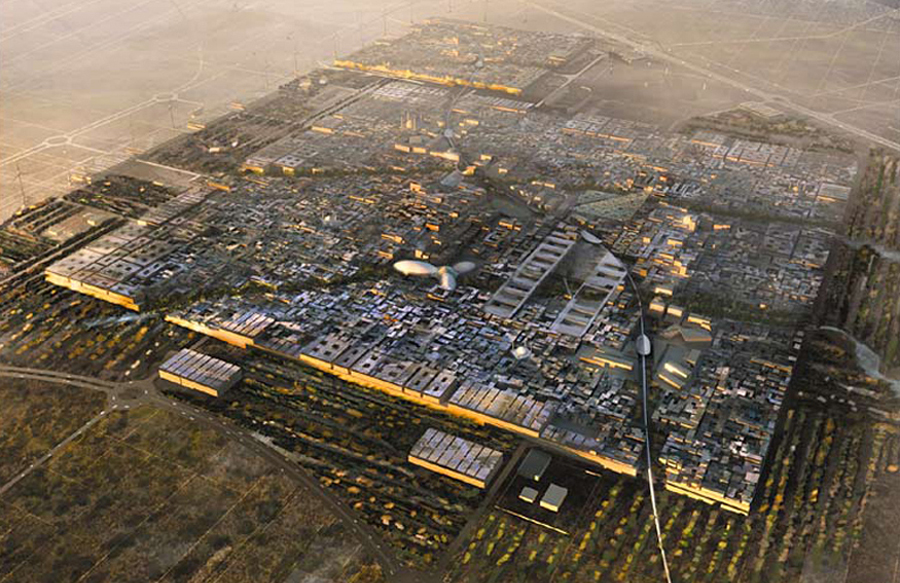 Masdar City Masterplan. Copyright Masdar, Foster+Partners When Masdar City was first announced in 2007 by the Masdar Initiative, it claims that, when completed, it will become the world’s first zero carbon, zero waste development, while maintaining the highest quality of living. Foster + Partners and a team of environmental consultants including WSP and Transsolar have been appointed by Masdar to design the masterplan and the first stage of the project which broke ground in February 2008.
Masdar City’s Master plan is claimed to “meet and exceed” the principals of One Planet Living (OPL), a set of ten guiding principles of sustainability, proposed in a joint initiative by WWF, the global conservation organization and Bioregional Development, whereby everyone lives within their fair share of the Earth’s resources. The principles include Zero Carbon, Zero Waste, Sustainable transport, Sustainable materials, Sustainable water, and Sustainable culture and heritage.
The project also comes in the context of a rapidly increasing population and an economic boom in Abu Dhabi which -, together with new laws opening the emirate’s real estate to the free market- led to speculation and a housing shortage estimated in 2008 to between 35,000 and 50,000 dwelling units. This shortage has prompted the state to allocate billions for the construction of residential buildings, especially for foreign workers and western expatriates. This housing shortage has also resulted in rising house prices, which led to discussion of legislations that would introduce a 20 per cent quota for low-income housing in future developments.
Continue reading Masdar City Masterplan Reviewed
|
|