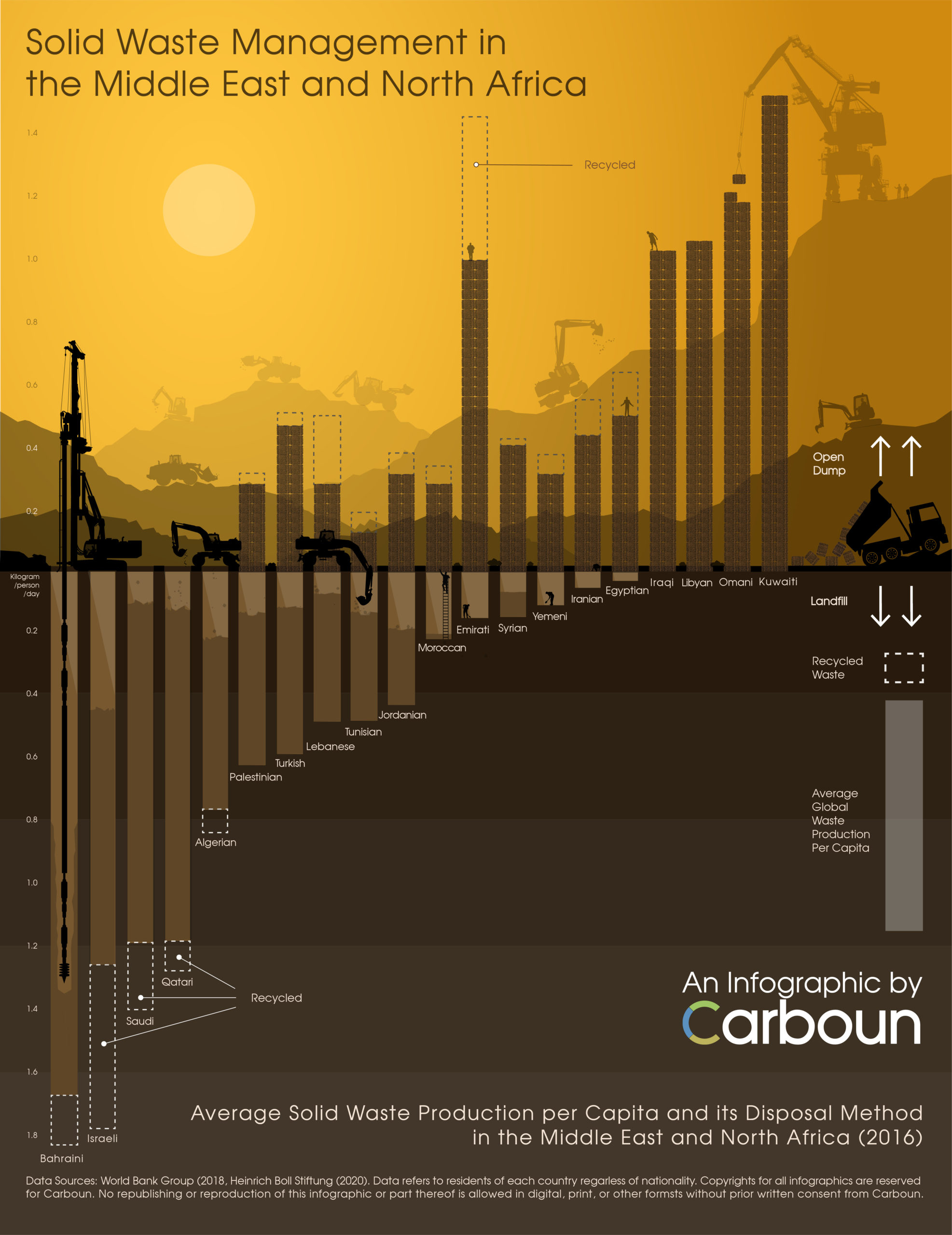
The Middle East and North Africa generates slightly more Municipal solid waste per capita than the global average. Yet per capita waste generation widely between regional countries that have high levels of material consumption and waste generation and others with much lower levels of consumption. This variation is most obvious between the GCC countries on the one hand, and the Levant and North African countries on the other.
With an average of 1.5 kilograms of municipal solid waste generation per person per day in the GCC, waste generation is more than double that of the average Levant and North Africa resident, which is estimated at 0.7 kilograms. One exception to this is Israel, which at 1.77 kilograms of solid waste per capita per day, is higher than the GCC average.
Since the start of the industrial age at the end of the 19th century, global surface temperatures have been on the rise due to increased carbon emissions. It is estimated that the earth’s surface temperature has already increased by an average of 0.9° C since then with obvious impacts on the global climate patterns.
The pattern of such warming has varied between different regions. Even within certain regions, sub-regional variations can be detected. In the Middle East and North Africa region, for example, there are sub-regional variations in how countries have warmed between 1880 and 2019, which correlate with their proximity to the Mediterranean Sea or the Persian/Arabian Gulf.
Following the UNFCCC’s 23rd Conference of Parties in Bonn (COP23), Carboun has released a visual guide to climate change in the Middle East and North Africa region. The visual guide comprises two infographics covering carbon emissions in the Middle East and North Africa and climate change impact. The aim of this infographic is to explain carbon emissions from the Middle East and North Africa and the Arab World regions in the global context, especially the relationship between total emissions, per capita emissions, and emissions per unit of GDP. This infographic is the second of two representing the visual guide to climate change in the Middle East and North Africa region. The first part can be viewed here. The guide, which was researched and designed by Karim Elgendy, was based on raw data provided by a variety of sources and datasets (all of which are listed on the infographics). It represents an update of a previous visual guide published in 2011, which also aimed to contextualize regional carbon trends. Copyrights for all infographics are reserved for Carboun. No republishing or reproduction of this infographic or part thereof is allowed in digital, print, or other formsts without prior written consent from Carboun.
In Pursuit of Sustainable Energy Sources : Challenges and Solutions
Karim Elgendy, Founder and Coordinator of Carboun, was recently commissioned by Frederich Ebert Foundation (Frederich Ebert Stiftung) to produce a set of visual guides to renewable energy in the Arab World to coincide with the 23rd Conference of Parties (COP23). The infographic below is the third of three visual guides. It represents an analysis of the challenges facing renewable energy growth in the Arab World. The three guides, which were researched and designed by Karim Elgendy for the Frederich Ebert Foundation, were based on raw data provided by International Renewable Energy Agency (IRENA), Regional Center for Renewable energy and Energy Efficiency (RCREEE), Lazard, World Energy Council, and Bloomberg. Copyrights for this infographic are reserved for the Frederich Ebert Foundation and the author. No reproduction or republishing of any infographic or part thereof without prior written consent from Frederich Ebert Foundation and the author. Guide 1 covers the state of the region and Guide 2 covers Regional Aspirations. They can also be reached via the infographics page.
In Pursuit of Sustainable Energy Sources : Regional Aspirations
Karim Elgendy, Founder and Coordinator of Carboun, was recently commissioned by Frederich Ebert Foundation (Frederich Ebert Stiftung) to produce a set of visual guides to renewable energy in the Arab World to coincide with the 23rd Conference of Parties (COP23). The infographic below is the second of three visual guides. It represents a review of plans and aspirations to grow renewable energy capacities in the Arab World and the scale of planned increase in renewable energy capacity. The three guides, which were researched and designed by Karim Elgendy for the Frederich Ebert Foundation, were based on raw data provided by International Renewable Energy Agency (IRENA), Regional Center for Renewable energy and Energy Efficiency (RCREEE), Lazard, World Energy Council, and Bloomberg. Copyrights for this infographic are reserved for the Frederich Ebert Foundation and the author. No reproduction or republishing of any infographic or part thereof without prior written consent from Frederich Ebert Foundation and the author. Guide 1 covers the state of the region and Guide 3 covers Challenges and Solutions. They can also be reached via the infographics page.
In Pursuit of Sustainable Energy Sources : The State of the Region
Karim Elgendy, Founder and Coordinator of Carboun, was recently commissioned by Frederich Ebert Foundation (Frederich Ebert Stiftung) to produce a set of visual guides to renewable energy in the Arab World to coincide with the 23rd Conference of Parties (COP23). The infographic below is the first of three visual guides. It represents an analysis of the state of renewable energy in the Arab World region in its regional context. The three guides, which were researched and designed by Karim Elgendy for the Frederich Ebert Foundation, were based on raw data provided by International Renewable Energy Agency (IRENA), Regional Center for Renewable energy and Energy Efficiency (RCREEE), Lazard, World Energy Council, and Bloomberg. Copyrights for this infographic are reserved for the Frederich Ebert Foundation and the author. No reproduction or republishing of any infographic or part thereof without prior written consent from Frederich Ebert Foundation and the author. Guide 2 covers Regional Aspirations and Guide 3 covers Challenges and Solutions. They can also be reached via the infographics page.
Following the UNFCCC’s 23rd Conference of Parties in Bonn (COP23), Carboun has released a visual guide to climate change in the Middle East and North Africa region. The visual guide comprises two infographics covering carbon emissions in the Middle East and North Africa and climate change impact. The aim of this infographic is to explain carbon emissions from the Middle East and North Africa region in the global context, especially how they relate to economic development, climate change, and climate committments under the Paris Agreement. This infographic is the first of two representing the visual guide to climate change in the Middle East and North Africa region. The second partcan be viewed here.The guide, which was researched and designed by Karim Elgendy, was based on raw data provided by a variety of sources and datasets (all of which are listed on the infographics). It represents an update of a previous visual guide published in 2011, which also aimed to contextualize regional carbon trends. Copyrights for all infographics are reserved for Carboun. No republishing or reproduction of this infographic or part thereof is allowed in digital, print, or other formsts without prior written consent from Carboun.