|
|

Karim Elgendy
Following the UNFCCC’s 23rd Conference of Parties in Bonn (COP23), Carboun has released a visual guide to climate change in the Middle East and North Africa region. The visual guide comprises two infographics covering carbon emissions in the Middle East and North Africa and climate change impact. The aim of this infographic is to explain carbon emissions from the Middle East and North Africa region in the global context, especially how they relate to economic development, climate change, and climate committments under the Paris Agreement. This infographic is the first of two representing the visual guide to climate change in the Middle East and North Africa region. The second partcan be viewed here.The guide, which was researched and designed by Karim Elgendy, was based on raw data provided by a variety of sources and datasets (all of which are listed on the infographics). It represents an update of a previous visual guide published in 2011, which also aimed to contextualize regional carbon trends. Copyrights for all infographics are reserved for Carboun. No republishing or reproduction of this infographic or part thereof is allowed in digital, print, or other formsts without prior written consent from Carboun.
Continue reading Climate Change in the Middle East and North Africa : Carbon Emissions
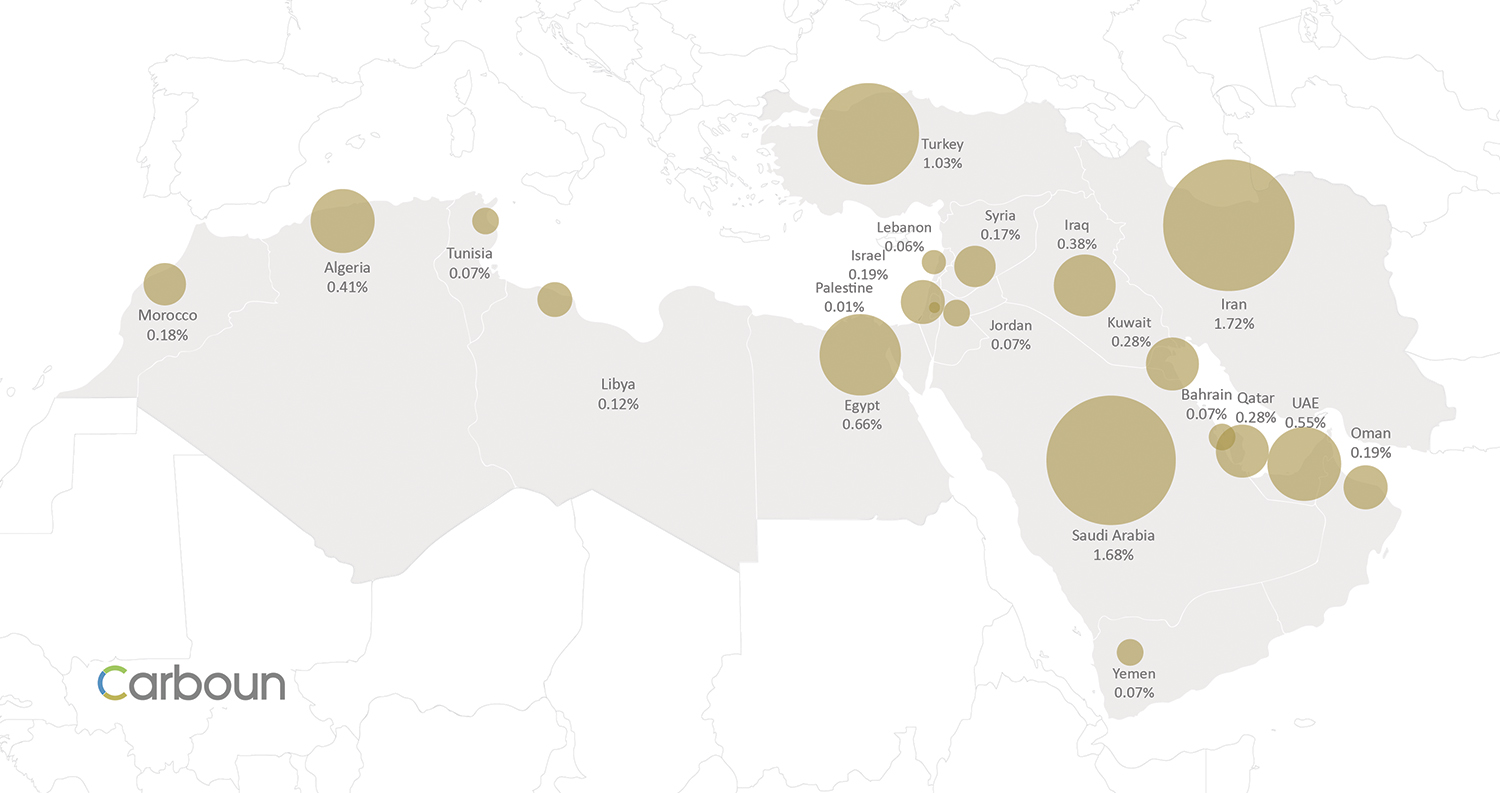 National share of 2014 global carbon emissions across the Middle East and North Africa region, including Turkey, Iran, and Israel. Copyrights: Carboun Karim Elgendy
The two-week COP 21 climate conference in paris (also known as the 21st Conference of Parties to the United National Framework Convention for Climate Change ) ended on Saturday 12 December with an adopted agreement covering 195 countries, and providing a framework for voluntary efforts to significantly reduce carbon emissions starting 2020.
Continue reading From Paris to Marrakech and Beyond

Karim Elgendy and Joumana al Jabri
An infographic comparing the two extreme urbanisms of Dubai and the Gaza Strip. While the two urban regions demonstrate surprising similarities when their geographic and demographic data are compared, their political and socio-economic conditions have produced urbanisms that are radically different and equally unsustainable.
A version of this infographic was first published by Portal 9 Magazine under “Reading Gaza Through Dubai”. Copyrights for the infographic are reserved for the Authors above. No reproduction or republishing of theinfographic or any part thereof is permitted without prior written consent from the authors. To discuss this infographic, please join Carboun’s discussion group on Linkedin. For news and updates on sustainability in cities around the region, join Carboun’s Facebook page or follow its Twitter feed. Continue reading Two Unsustainable Urbanisms: Dubai and Gaza

Guy El Khoury
Despite the increasing global interest in renewable energy sources, electricity generation remains largely dependent on fossil fuels with approximately 70% of the world’s electricity currently being generated using coal, natural gas, and petroleum products. Coal, the most carbon intensive of the fossil fuels, accounts for the largest share of electricity generated globally, with 40% of all electricity generated.
Such reliance on fossil fuels is coupled with a relatively low conversion efficiency from fossil fuels to electricity, which averages 35%. The remaining 65% of the energy contained in fuels used is in effect wasted, lost as heat in power plant turbines and generators.
In this context, it is not surprising to learn that electricity generation stands as the top contributor to global Carbon emissions. According to the International Energy Agency (IEA), electricity generation currently accounts for approximately 50% of global carbon emissions.
In the Middle East and North Africa region, electricity and heat production are responsible for 41% of total carbon emissions according to IEA data from 2009. And while not representing a consumption sector, electricity generation ranked well higher than any individual sector, including transportation, which comes second and accounts for 25% of the region’s total carbon emissions. Yet carbon emissions from electricity generation is not equal across the region. In fact, the top 5 contributors to carbon emissions from electricity generation – namely Saudi Arabia, Egypt, the UAE, Kuwait, and Iraq – together represent 70% of the region’s electricity generation carbon emissions, according to 2009 data by the IEA, a share that represents approximately 30% of the region’s total carbon emissions.
Continue reading Carbon Footprint of Electricity in the Middle East

Karim Elgendy
In celebrating this year’s World Green Building Week, Carboun has released a visual guide to energy use in buildings with the goal of explaining the overall state of energy use in the region and the significance of buildings as a major sector in energy consumption. It also aims to comparatively explain the nuances of the major trends of energy use in buildings as a baseline analysis for further research. The visual guide, which was researched and designed by Karim Elgendy with additional contributions from a small research team, was based on raw data obtained from the International Energy Agency and the World Bank. Copyrights for all infographics are reserved for Carboun. No reproduction or republishing of any infographic or part thereof is permitted without prior written consent from the author.
Continue reading A Visual Guide to Energy Use in Buildings in the Middle East
Guy El Khoury
A year ago, in March 2011, a tsunami swept parts of the eastern coast of Japan and caused a major accident at the Fukushima-Daiichi power plant, leading to widespread radioactive material leakage and a sharp increase in radioactivity in nearby areas. Being the most notable accident since Chernobyl, it restarted the debate on nuclear energy option both in Japan and around the world. In Germany, this debate soon led to a decision to terminate the federation’s civilian nuclear program with a commitment to develop renewable energy alternatives, as well as additional thermal power plants, to cover the energy shortfall. A similar debate on nuclear energy has also emerged in the Middle East and North Africa region (MENA) where a number of countries have been exploring nuclear energy option for years, but have not been able to turn their nuclear ambitions to realities due to their lack of technical capability, fear of nuclear proliferation, and lack of sufficient financial resources. This debate was further brought to the fore with the recent move by the United Arab Emirates (UAE) to develop a civilian nuclear program and the operation of the Bushehr plant in Iran, and has proven to be quite divisive with strong positions arguing for and against nuclear energy
Continue reading Nuclear Desert
Karim Elgendy and Wissam Yassine
Developing transportation networks and facilitating access and mobility are major constituents of the economic development of any country or region. Yet transportation also poses great economic and environmental challenges as a major energy consumer and a major contributor to global greenhouse gas emissions.
In the Middle East, the transportation sector is challenged on both fronts. On one hand, its underdeveloped and inefficient networks continue to hinder economic development. In addition, the transportation sector represents a major consumer of energy in the region and a primary contributor to carbon emissions. In 2008, the transportation sector was estimated to be responsible for 31% of the region’s total energy use – a relatively high proportion compared to the global average of 27% – while the road sub-sector alone was responsible for 18% of energy use – compared to 14% globally.
Continue reading Sustainable Transportation in the Middle East
|
|